
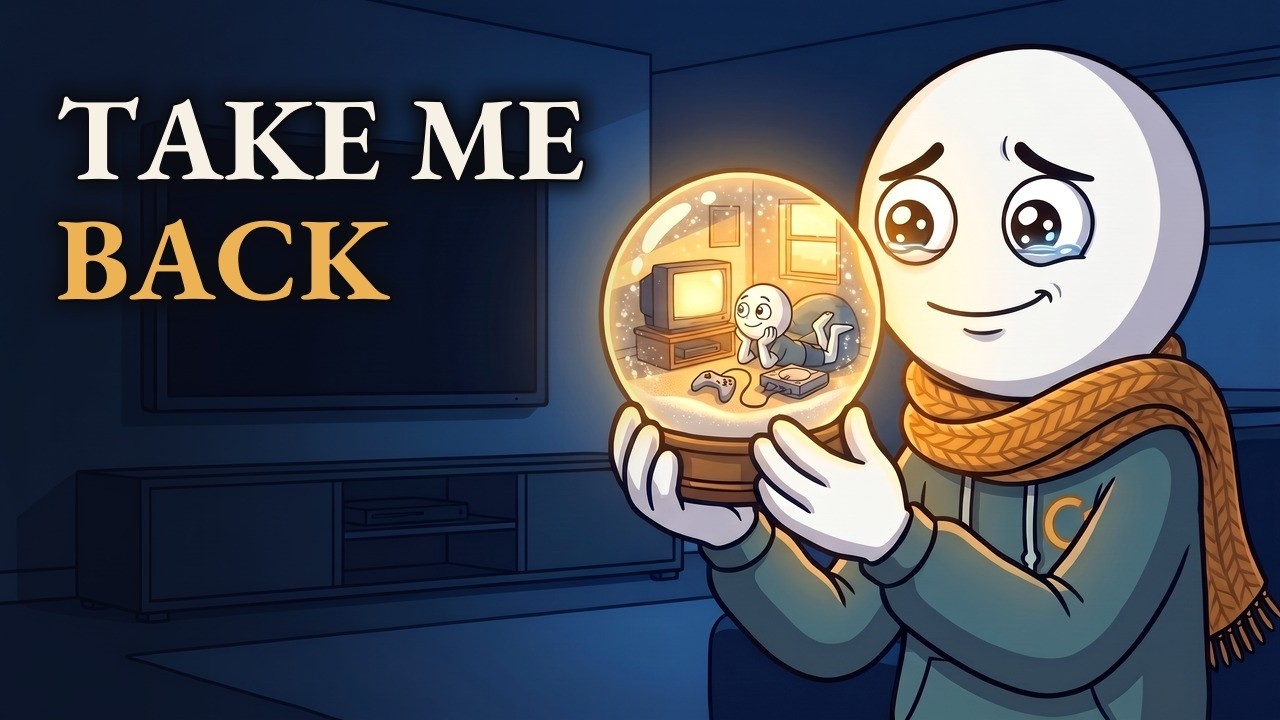
It’s 11:20 at night. The work is done, the bills are paid, the front door is locked. On the big screen in front of you is almost every film, album and game you wanted when you were twelve. You turn it off. You lie back in the dark, open your phone, and stop on a twenty-second clip from 2001: two boys on a carpet in front of a boxy television. Nothing happens in it. Under the clip, thousands of grown adults are leaving notes. Under a video of an empty bedroom from 2004, someone passed on a line they had seen somewhere else: “I’m in my house, but I want to go home.”
So why do we miss the 2000s when we have more than we had then? Not because the decade was better, and not only because we were young. We miss it because it is the last place we remember being allowed to be soft, before we grew the armor that now keeps out the good things along with the bad.
What was in that ordinary afternoon?
Nobody in those clips is on holiday or winning a prize. It’s an ordinary afternoon, twenty-odd years ago. To see why it pulls so hard, go back to the person you were before you learned how to fight.
It’s 4:30 on a Tuesday afternoon in 2004. On a green carpet, a twelve-year-old is reading the same gaming magazine for the twentieth time. One issue came out each month, and in the middle pages sat four tiny pictures of a game he couldn’t afford. Four small pictures on paper could make his heart race. Tonight, three hundred games barely make you blink.
Scarcity is part of it, but look at the room again. There is no scoreboard in it. Nobody is grading his Tuesday. He doesn’t have to look confident or unbothered. When he’s bored, he lies flat on the floor. When he’s excited, it shows on his face. When he’s scared, he walks down the hall to his parents’ room.
He walks through the world without armor, with skin thin enough that a small thing can still get through. And lying on that carpet, he hates feeling small and dependent. So he makes himself a quiet promise: one day I’ll be strong, I’ll handle everything myself, and nobody will ever make me feel weak again.
How does the armor form?
You grew up and kept that promise. Nobody told the twelve-year-old what strong costs. Out here, people lean on you. A team waits for your call. A parent’s voice on the phone sounds a little older every month. So you built the most useful thing an adult can own: calm, efficient numbness.
Monday, 8:30 in the morning. The project you have carried for six months is about to fall over, and every face in the room turns to you. You open your mouth to ask for help, then swallow it. “I’ve got it.” The room relaxes, and someone slides one more project across the table. That’s the deal: the one who handles things gets handed more.
The armor works. It wins you a career, a home and people’s respect. Which leaves a strange question. If it won you everything, why does none of it reach you?
Why does the reward feel like nothing?
Ten-fifteen that night. Time to enjoy what you worked for. You scroll the whole library and feel nothing. The same plates that kept out the panic this morning keep out the joy tonight. Armor can’t tell a blow from a gift. It stops both.
At ten-forty, an email comes in: Can we talk tomorrow at nine? At twelve, when you were scared, you had a hallway to walk down. Tonight yours ends at the fridge. You type “you awake?” to someone you used to be close to, wait, and delete every letter. Asking would mean opening the shell first. On the other end, they only see another quiet phone, so they pull back and harden their own shell too.
That’s why “I’m in my house, but I want to go home” lands the way it does. Home was the last place you didn’t need the armor. And one guarded person makes the next person more guarded, until a whole street of people sit ten feet apart behind their own walls.
Was nostalgia once a disease?
When the world outside turns that cold, the mind keeps going back to the one memory that still hurts. That ache has a history.
In 1688, a medical student in Basel wrote his thesis about a strange illness. People far from home were coming down with fevers, a racing heart, weakness, and a sadness that would not lift. He named it from two Greek words, homecoming and pain: nostalgia. A generation later, another Basel doctor claimed that a single herdsmen’s song could bring it on in Swiss soldiers serving abroad. By Napoleon’s wars, army doctors were writing it up among their troops. For nearly two centuries, missing home was something you could be diagnosed with.
Then, in 2008, a group of psychologists turned the question around. Not what is wrong with people who feel this? but when does it come, and what does it do? It came when people felt lonely, and afterwards they felt more supported. In a later study, the same researchers put people in a room a few degrees too cool, and it came again. The people who felt it said they felt warmer.
The ache was never the sickness. It’s what the mind does when it’s cold. So what is cold in a warm living room, late at night, with everything you ever wanted on the screen?
Why can’t anything soak in?
Under the armor, something else has been piling up. Every time life cut you, every quiet disappointment, every panic you hid, every grief you didn’t have time to mourn, you didn’t stop to heal it. You buckled the armor tighter over the wound and showed up on time the next morning. Year after year the wounds stayed there, unnamed, with nowhere to surface, and the ground underneath was baked as hard as desert clay.
Pour a flood over baked clay, ten thousand films and every game you ever wished for, and it runs straight off, like rain down a closed window. You aren’t bored with the games. You’re parched, and nothing can reach you through the crust.
Then, at 11:20 at night, wandering half-numb through an endless desert of feeds, you hit a twenty-second clip from 2001. It’s like a traveler finding a small pool of water in the dark. Twenty seconds of a life before the armor slip past your defenses. Your chest tightens. Everything tangled underneath rises toward the surface. And right on cue the voice inside the armor tries to shut the door: Don’t get soft. Scroll past. Sleep so you can fight tomorrow.
Your thumb stops over the glass. For nearly two centuries they called this a disease. The ache in your chest isn’t weakness. It’s the sound of baked earth cracking open to drink, and proof that the person inside the armor is still alive.
What happened to the kid on the carpet?
Remember his promise. One day I’ll be strong. I’ll handle everything myself. Nobody will ever make me feel weak again.
You kept it, every word. You handle everything. Nobody sees you weak, not at work, not with friends, sometimes not even at home. He wanted to be safe. He didn’t know that safe would come sealed.
So when the house goes quiet, you go looking for 2001, the last place you remember being allowed to be soft. Tomorrow the alarm will go off and the armor will close again. You have kept that kid’s promise for twenty years. If you still have to sneak back to his afternoon just to feel alive, what was all that fighting for? He’s still on that sunlit carpet, waiting, while another night of the life he dreamed about slips into the dark.
Memory has its own part in this: it edits the boredom out of those afternoons and repaints them warmer each time we replay them. That is where the episode on GTA 6 and why nothing feels as fun anymore picks up. New episodes of The Counterloop come out on YouTube.
Sources
- Hofer, J. (1688). Dissertatio medica de nostalgia, oder Heimwehe. Basel.
- Zwinger, T. (1710), Basel: the herdsmen’s song (Kuhreihen) as a trigger of Swiss homesickness, as summarised by the Swiss National Museum and swissinfo. Whether the song was ever banned is disputed.
- Battesti, M. (2016). “Nostalgia in the Army (17th–19th Centuries).” Frontiers of Neurology and Neuroscience, 38. PubMed 27035922.
- Zhou, X., Sedikides, C., Wildschut, T., & Gao, D.-G. (2008). “Counteracting loneliness: On the restorative function of nostalgia.” Psychological Science, 19(10), 1023–1029.
- Zhou, X., Wildschut, T., Sedikides, C., Chen, X., & Vingerhoets, A. J. J. M. (2012). “Heartwarming memories: Nostalgia maintains physiological comfort.” Emotion, 12(4), 678–684.
- YouTube clips and public comments: Friends Playing PS2 In 2001 (
a-i1GT_kCN0) and a winter 2004 room ambience video (bepGYHbvIKI).